As múltiplas facetas das ervas marinhas na mitigação de impactes globais - Conversas com Ciência (Serralves)
Local: Lagar – Quinta de Serralves
Date: 15 NOV 2020
Researcher: Marina Dolbeth
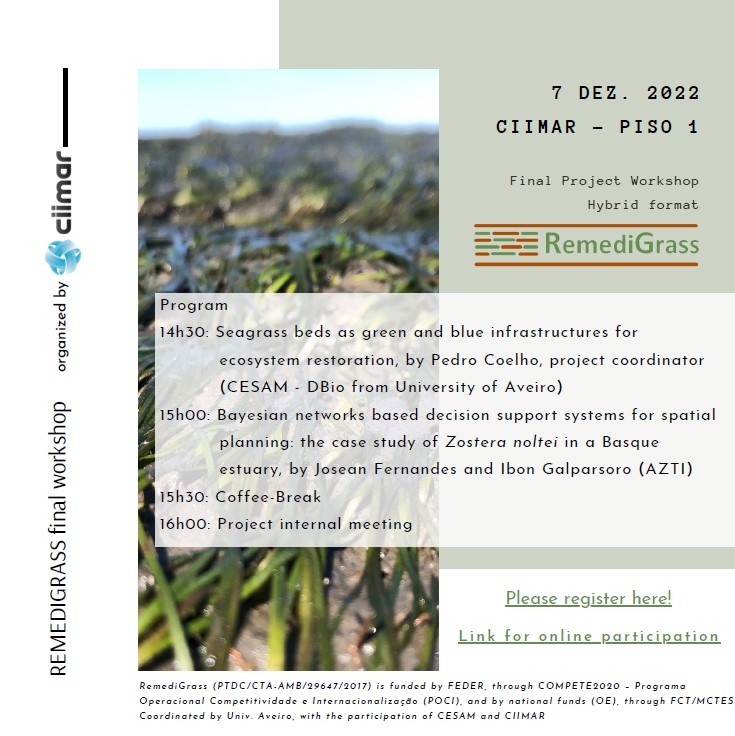
“(…) Nesta conversa vamos falar sobre as ervas marinhas, como exemplo dos “super-heróis” do meio marinho, do seu papel enquanto soluções da Natureza para a proteção e mitigação de impactes globais, bem como das principais ameaças à sua sobrevivência e sobre algumas das iniciativas locais para a sua proteção (ex. projetos REMEDIGRASS e REMOLIÇO).“
“(…) Historicamente, o contaminante alvo de mais estudos científicos na Ria de Aveiro é o mercúrio, preocupante devido à sua elevada toxicidade (com efeitos adversos no sistema nervoso central) e à sua capacidade de acumular nos organismos e ser transferido ao longo das cadeias tróficas. (…) com o intuito de minimizar os riscos de remobilização dos sedimentos, estão em curso projetos piloto que visam a sua estabilização nesta zona através de soluções baseadas na natureza, por exemplo pela recolonização com vegetação nativa (pradarias de ervas marinhas)“
Pergunte a um cientista do CESAM – contaminantes na Ria de Aveiro
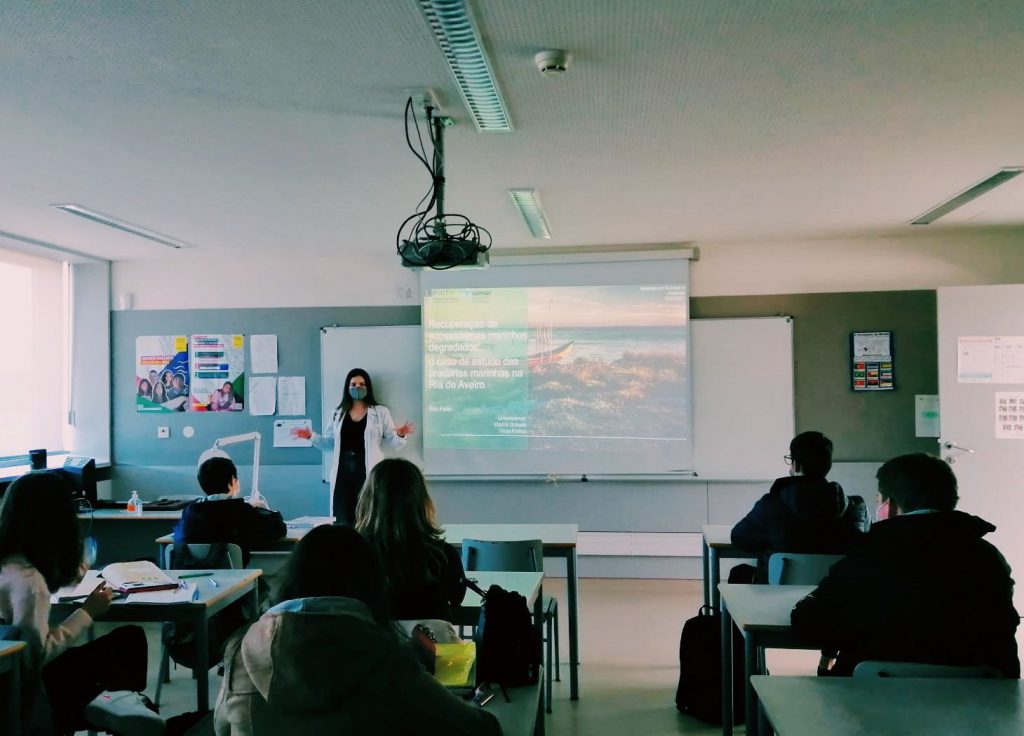
A nature-based solution to enhance local invertebrate diversity
Local: Universidade do Porto
Date: 5 May 2021
MSc Student: Tiago Ribeiro
Presentation: Oral Presentation
Local: Universidade do Porto
Date: 7 JUN 2021
MSc Student: Tiago Ribeiro
Presentation: Oral Presentation
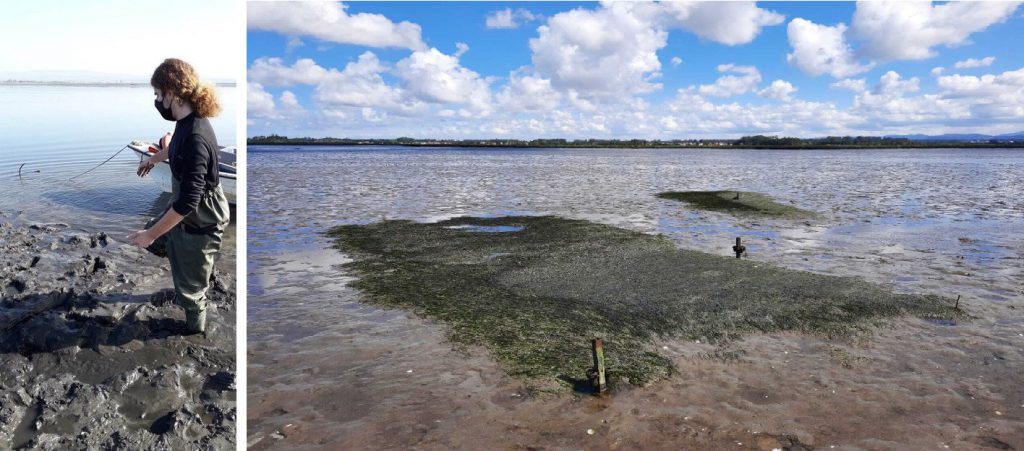
“(…) investiga as comunidades de invertebrados na Ria de Aveiro para verificar a aplicabilidade de um novo método para reabilitar ecossistemas costeiros. As comunidades de invertebrados da Ria de Aveiro estão a ser usadas de modo a avaliar o sucesso de uma experiência piloto para reabilitar zonas da Ria expostas a poluição por mercúrio no passado. A abordagem passa pelo transplante de plantas aquáticas designadas “ervas marinhas” nos sítios contaminados, de forma que a presença das ervas impeça que os animais sejam expostos ao mercúrio (…)“
“With the recent declaration of the 2021-2030 UN Decade on Ecosystem Restoration, seagrass restoration efforts are in the spotlight, given the ecosystem functions that support the vital services they provide (e.g., carbon and nutrient sinks, biodiversity enhancement and coastal erosion prevention). Within this framework, seagrass re-colonization is currently being tested as a blue-green infrastructure for restoring historically contaminated ecosystems. The overarching goal of this work is to evaluate the use of Zostera noltei as a remediation tool in the Ria de Aveiro (Portugal).”
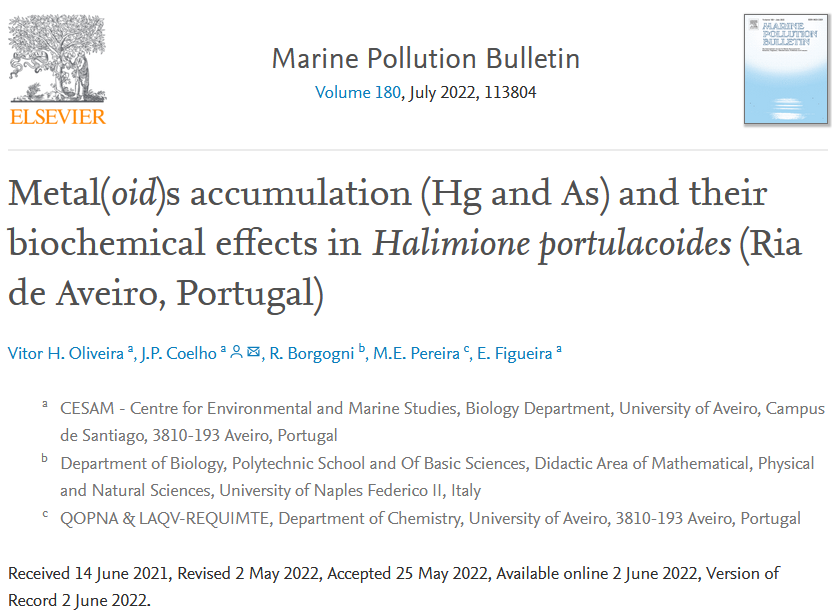
For decades, mercury (Hg) and arsenic (As) were discharged into the Aveiro Lagoon. This study was designed to assess the natural attenuation process evolution by: (1) evaluating Hg and As concentration in sediments and in Halimione portulacoides, and assess the long-term evolution of a historically contaminated salt-marsh system; (2) evaluating the stress levels imposed by Hg and As, and the mechanisms triggered to squash oxidative damage. Concentrations of Hg and As in sediments varied considerably between sampling locations. H. portulacoides did not bioconcentrate Hg and As, restricted translocation to aerial biomass and immobilized contaminants in cell walls. The ions that reached the cytosol induced oxidative stress, restrained by antioxidant mechanisms, especially SOD and CAT activity. Results show that after 25 years of natural attenuation, contamination decreased in the sediment, but remains above non-contaminated systems and continues to induce toxicity in the saltmarsh halophyte community, evidencing the persistent effect of Hg and As contamination.
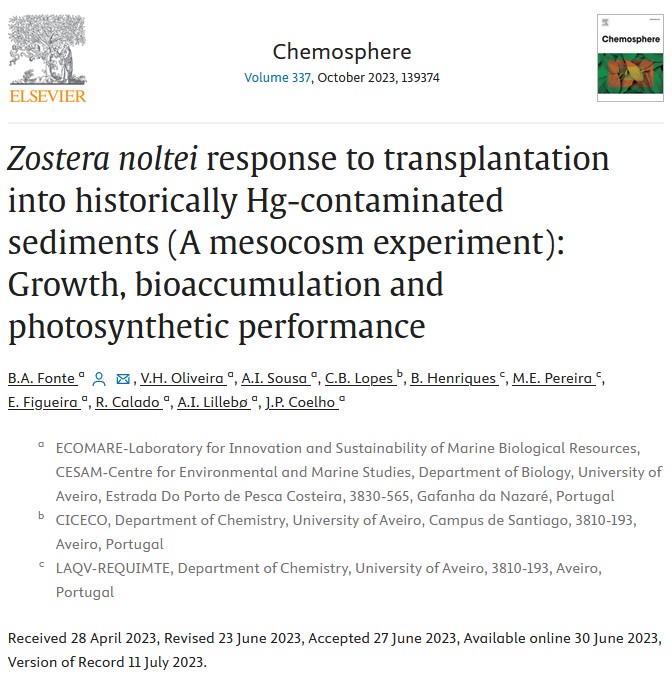
The present study aimed to evaluate the effectiveness of seagrassrecolonization as a nature-based solution for the recovery of a coastal area historically contaminated by mercury (Laranjo Bay, Ria de Aveiro, Portugal). A mesocosm approach was employed to assess the resistance of Zostera noltei to transplantation into contaminated sediments collected in-situ (0.5–20 mg kg−1 Hg). At each sampling time (15, 30, 60, 120 and 210 days), the resistance of transplanted Z. noltei was evaluated through growth parameters (biomass and coverage area), photosynthetic performance and elemental composition. Although some significant differences (p ≤ 0.05) were observed between treatments, essentially associated with the elemental composition of plant tissues, the most relevant variations were associated with seasonality. Overall, plants were found to not be affected by sediment contamination, under the tested concentrations, suggesting that recolonization with Z. noltei can be an effective restoration strategy for historically contaminated coastal areas.
Seagrass meadows provide several ecological functions that improve the overall ecological health of coastal systems and therefore, it is urgent to promote the restoration of such habitats. In Ria de Aveiro, a coastal lagoon in the Atlantic Coast of Portugal, a restoration initiative was responsible for transplanting the dwarf eelgrassZostera noltei into a highly degraded area. This eelgrass was used as a nature-based solution (NbS) to mitigate some of the impacts of historical mercury contamination. Comparisons of key-species features (density and biomass), and some community-derived indicators (total density and biomass, species richness and Shannon-Wiener index) between the transplanted seagrass patch, their bare vicinities, and their counterpart habitats on the source area, provided signs of the effectiveness of the restoration action on the benthic communities’ recovery. Indicators were higher within the restored meadow, and biomass derived indicators of the restored meadow were similar to the source meadow.
Mercury’s extreme toxicity and persistence in the environment justifies a thorough evaluation of its dynamics in ecosystems. Aveiro Lagoon (Portugal) was for decades subject to mercury effluent discharges. A Nature-based Solution (NbS) involving Zostera noltei re-colonization is being tested as an active ecosystem restoration measure. To study the effect of Zostera noltei on the sediment contaminant biogeochemistry, seasonal (summer/winter) sediment, interstitial water and labile mercury vertical profiles were made in vegetated (Transplanted and Natural seagrass meadows) and non-vegetated sites (Bare-bottom area). While no significant differences (p > 0.05) were observed in the sedimentary phase, Zostera noltei presence reduced the reactive/labile mercury concentrations in the top sediment layers by up to 40% when compared to non-vegetated sediment, regardless of season. No differences were found between vegetated meadows, highlighting the fast recovery of the contaminant regulation ecosystem function provided by the plants after re-colonization and its potential for the rehabilitation of historically contaminated ecosystems.
This article provides a comprehensive study of ecosystem rehabilitation methods widely used in the 21st century, focusing on Europe. The review covers the evolution and trends in scientific article publication, identification of European countries demonstrating high publication outputs, collaboration patterns, leading journals, and thematic areas. Additionally, it examines primary stressors in European aquatic ecosystems, and different methods and treatments commonly employed for remediation purposes. The analysis of selected articles revealed a significant increase in studies over time, driven by public awareness and financial incentives from national, European and global organizations. Italy, Portugal and Spain were the leading countries in degraded ecosystem rehabilitation studies, mainly focusing on remediating contaminated areas where metals were identified as the primary stressor (chemical pollution). Chemical remediation method emerged as the most used, closely followed by biological remediation method, which have gained prominence in recent years due to their ecological, economic, and social combined benefits. Furthermore, recent studies demonstrate a growing trend towards the combined use of more than one treatment/method to rehabilitate ecosystems, particularly with biological treatments. This combined approach has the potential for synergistic effects in achieving more effective rehabilitation and their sustainability in the long term, thus, a focus for future research.
Within the UN Decade on Ecosystem Restoration (2021–2030) framework, a Nature-based Solution (NbS) using Zostera noltei transplants was tested to restore a historically contaminated intertidal area. In-situ transplantation relied on patches of seagrass and sediment from a Donor meadow and its evolution was monitored for two years. The evaluation of the transplant success encompassed the seagrass coverage area, seagrass biomass, tissue mercury (Hg) accumulation, and photosynthetic efficiency. The transplant was successful, with gradual increases in the coverage area in the target area indicating adaptation to local conditions already after the first year. Although some significant differences were observed in biomass and tissue Hg concentration over time, the similar translocation factors suggest the plant has effective defensive mechanisms to prevent accumulation and cellular damage. Additionally, the normal seasonal pattern of photosynthetic parameters indicates that contamination is not impeding its photosynthetic performance and growth, suggesting this NbS as a viable restoration strategy.
In the midst of the UN Decade on Ecosystem Restoration and newly approved EU Nature Restoration Law, ecosystem restoration efforts have gained momentum. Still, monitoring tools and early warning protocols to evaluate restoration success are necessary. This study aimed to assess the suitability of using biochemical response parameters to evaluate Z. noltei tolerance to transplantation and various abiotic conditions (including metal(loid) concentrations) across different tissues and seasons, following restoration. The results indicate that the proposed monitoring strategy successfully highlighted the adaptation and acclimation phase of transplanted plants, as well as the tolerance to the conditions at the Transplant site by activating mechanisms to mitigate or reduce oxidative stress. The findings validate the use of biochemical response parameters as a measure of transplant success and early warning signal for plant maladjustment in the scope of ecosystem restoration actions in historically contaminated areas.
Efforts to remediate and restore degraded ecosystems through Nature-based Solutions (NbS) have intensified during the United Nations Decade for Ecosystem Restoration (2021–2030). To evaluate the potential of seagrass transplantation for recovering historically contaminated areas, a mesocosm experiment was performed with the following objectives: 1) assess the suitability of the transplant method; 2) evaluate the tolerance of Zostera noltei to different concentrations of metal(loid)s in sediments; 3) clarify the tolerance mechanisms and measure oxidative stress levels and energy budget across different tissues and sampling times; and 4) investigate its potential as a Nature-based Solution. Results demonstrated that seagrass could tolerate various concentrations of metal(loid)s in sediments and activate mechanisms to reduce oxidative stress, without interfering with its growth and seasonal life cycle. The use of Zostera noltei as a NbS for remediating, restoring, and rehabilitating historically contaminated areas was validated and appears to be a promising approach.
A Nature-based Solution (NbS) using Zostera noltei transplants was implemented to restore an area historically contaminated with metals and enhance local environmental conditions. However, the benefits of this restoration approach on the health of resident benthic communities remained unclear, considering the time span of one year of implementation. This study evaluated the short-term effects of transplantation by evaluating bioaccumulation and biochemical responses in Scrobicularia plana and Hediste diversicolor. Overall, the transplanted vegetation played a crucial role in controlling contaminant accumulation, with both species exhibiting lower contaminant levels in vegetated sites compared to bare-bottom sites. The study also revealed species-specific responses to oxidative stress, antioxidant defences and energy budgets, with H. diversicolor being more vulnerable to the absence of vegetation than S. plana. These findings highlight the critical role of vegetation in improving environmental quality and promoting the health of benthic communities, validating the positive effect of the applied restoration measures.
Within the scope of an ongoing seagrass active restoration program at Ria de Aveiro, Portugal, the present work aimed at evaluating the recovery of Zostera noltei meadow nutrient regulation ecosystem function, by mediating Nitrogen and Phosphorus biogeochemical processes, and translated on the nutrient fluxes (PO4-P, NOx-N and NH4-N) at the sediment/water interface. This plant-mediated process was evaluated seasonally at three sites (Bare bottom, Zostera noltei Transplant and Natural meadow) and at two tidal conditions which required two distinctive methodologies: (a) the low tide pools during ebb, and (b) flux chambers during high tide. Sediments were collected in situ and physicochemical parameters determined.
At Zostera noltei transplanted areas, plant-mediated biogeochemical processes were found to reduce nutrient fluxes (both NH4-N and PO4-P) at the sediment/water interface, and its significance varied seasonally and along the tidal cycle. Furthermore, nutrient fluxes for both vegetated sites (Transplant and Natural) were similar, showcasing that the N and P biogeochemical processes and function were re-established no later than a year after transplantation.