
Ria de Aveiro
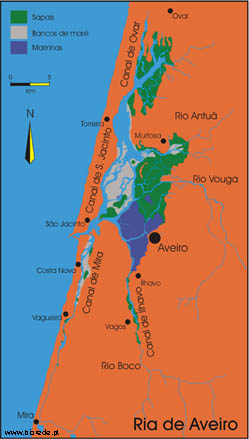
The Aveiro Lagoon, also called Ria de Aveiro (Figure 1) is located on the northwest Portuguese coast, between the coordinates 40°28′ N and 40°52′ N latitude and between 8°45′ W and 8°35′ W longitude.
The Ria de Aveiro is a mesotrophic shallow coastal lagoon (Almeida et al. 2005), separated from the Atlantic Ocean by a sand dune barrier. This Lagoon was connected with the Atlantic Ocean through an artificial channel (Dias 2001). Four main channels constitute the Lagoon: Mira, São Jacinto, Ílhavo and Espinheiro channels (Dias 2001) and has five main freshwater sources: Vouga, Antuã, Ribeira dos Moinhos, Cáster and Boco rivers. The main mechanisms controlling flooding at Ria de Aveiro lagoon are the tidal wave, the mean sea level, the storm surges, and the wind waves (Dias et al. 2000). Besides that, freshwater inflows from rivers and precipitation can also influence the inundation patterns (Pinheiro et al. 2020).
The Aveiro Lagoon is mainly controlled by the tide, which is predominantly semi-diurnal. Furthermore, the Lagoon is mesotidal with an average tidal range of 2 m, varying from 0.6 m at neap tides to 3.2 m at spring tides (Dias et al. 2000). Regarding the flooded intertidal areas under the most adverse spring tide conditions, former studies indicated a value of 89.2 km2 at high water and 64.9 km2 at low water tides (Lopes et al. 2013).
Historical Evolution of Contamination
The Aveiro Lagoon has been considered in the past one of the most mercury-contaminated systems in Europe (Válega et al. 2008) due to continuous discharges of mercury from a chlor-alkali industry during four decades (Pereira et al. 1998). During this time-lapse, it is estimated that about 33 tons of mercury have been discharged into the Laranjo Bay (Figure 2C), in two km2 inner bay of the Aveiro Lagoon (Pereira et al. 1998). Shallow intertidal plains and slow water currents promoted the sedimentation of contaminated fine particles in the Laranjo (Pereira et al. 1998). A well-defined contamination gradient in relation to Hg source was found in this system (Coelho et al. 2005).
This lagoon has a detailed record of pollutants and has been intensively studied in its abiotic and biological compartments. Recent findings highlight the on-going recovery of the system, while stressing the importance of long-term monitoring of estuarine processes (Coelho et al. 2014; Oliveira et al. 2018).
i

Contribution of the RemediGrass Project
With the Water Framework Directive (WFD) implementation, contemporary trace element contamination issues in aquatic systems will occur mainly through internal loading from sediment contaminant sinks. Due to human activities or natural processes, buried contaminants can be remobilized into the water column. Therefore, the recovery of historically contaminated areas is a complex process involving numerous variables, which will influence the decontamination process and the most suitable rehabilitation strategy (Wang et al. 2004).
Many remediation techniques have been tested around the world to address this environmental concern (Cho et al. 2007; Gomes et al. 2013), but the most accepted and sustainable method today is the process of natural attenuation. Although this strategy has no costs or impacts on the local communities, it is a very long process (time scale of decades) (Khan and Husain 2001; Weis et al. 2005). Therefore, there is a need for alternative, cost-effective strategies to enhance natural attenuation processes and shorten the time scale of ecosystem recovery.
Worldwide, seagrasses play a fundamental role in estuarine ecosystems. The acquired knowledge on the biology and ecology of seagrasses has driven increased awareness of the economic value of seagrasses to humans.
The biological resources and ecological services provided by seagrasses are based on the physical structure of the plants themselves and the underwater meadows they form, their biological activity, and that of the associated fauna and flora (Terrados and Borum 2004). It is well established that seagrass meadows enhance biodiversity and biological production over bare bottom sediments (França et al. 2009; Dolbeth et al. 2011), retain and stabilize the sediment by reducing current and wave re-suspension and increase habitat connectivity between river continuum, estuary, and open sea (trophic and nursery roles) (Marbà et al. 2006; Bos et al. 2007). In addition, seagrass cover has been considered to play an important role in sediment associated contaminant immobilization, given their moderate tolerance of anthropogenic contamination and recovery capacity after efficient management of pollution (Duarte et al. 2004; Ralph et al. 2006).
Given its recognized ecological value, being considered as important indicators of a good ecological status under the WFD, numerous seagrass recovery programs exist worldwide (Marbà et al. 2006; Bos et al. 2007), either through protection measures for self-recovery of existing meadows or re-colonization actions (Marbà et al. 2006). However, while salt marsh plants have been studied for their possible role in phytoremediation/phytostabilization (Reboreda and Caçador 2007; Marques et al. 2011), little information exists on seagrass efficiency for remediation purposes, limited to a study with Zostera marina (Huesemann et al. 2009).
After a significant decline of seagrass meadows in the Ria de Aveiro, these communities seem to be recovering (Sousa et al. 2019), and a small meadow (± 2m2) identified in the historical contaminated area. Therefore, this ecosystem presents itself as an ideal experimental location for a restoration and bioremediation pilot program.
With this, the main aim of the RemediGrass project is to improve the scientific knowledge on the ecological recovery process of historically contaminated estuaries and develop a cost-effective scheme for enhanced natural attenuation. For that purpose, the Ria de Aveiro was chosen as the ideal study site to evaluate seagrass re-colonization as a nature-based solution for ecosystem restoration, taking advantage of the privileged field conditions and contamination gradient.
References:
Almeida MA, Cunha MA, Alcântara F (2005) Relationship of bacterioplankton production with primary production and respiration in a shallow estuarine system (Ria de Aveiro, NW Portugal). Microbiol Res 160:315–328. https://doi.org/10.1016/j.micres.2005.02.005
Bos AR, Bouma TJ, de Kort GLJ, van Katwijk MM (2007) Ecosystem engineering by annual intertidal seagrass beds: Sediment accretion and modification. Estuar Coast Shelf Sci 74:344–348. https://doi.org/https://doi.org/10.1016/j.ecss.2007.04.006
Cho Y-M, Smithenry DW, Ghosh U, et al (2007) Field methods for amending marine sediment with activated carbon and assessing treatment effectiveness. Mar Environ Res 64:541–555. https://doi.org/10.1016/j.marenvres.2007.04.006
Coelho JP, Pato P, Henriques B, et al (2014) Long-term monitoring of a mercury contaminated estuary (Ria de Aveiro, Portugal): the effect of weather events and management in mercury transport. Hydrol Process 28:352–360. https://doi.org/10.1002/hyp.9585
Coelho JP, Pereira ME, Duarte A, Pardal MA (2005) Macroalgae response to a mercury contamination gradient in a temperate coastal lagoon (Ria de Aveiro, Portugal). Estuar Coast Shelf Sci 65:492–500. https://doi.org/10.1016/j.ecss.2005.06.020
Dias JM (2001) Contribution to the study of the Ria de Aveiro hydrodynamics. Aveiro University, 288 pp
Dias JM, Lopes JF, Dekeyser I (2000) Tidal propagation in Ria de Aveiro Lagoon, Portugal. Phys Chem Earth, Part B Hydrol Ocean Atmos 25:369–374. https://doi.org/10.1016/S1464-1909(00)00028-9
Dolbeth M, Cardoso PG, Grilo TF, et al (2011) Long-term changes in the production by estuarine macrobenthos affected by multiple stressors. Estuar Coast Shelf Sci 92:10–18. https://doi.org/10.1016/j.ecss.2010.12.006
Duarte CA, Marbà N, Santos R (2004) European seagrasses: an introduction to monitoring and management. In: Borum J, Duarte CA, Krause-Jensen D, Greve T (eds) What may cause loss of seagrasses? The M&MS project
França S, Costa MJ, Cabral HN (2009) Assessing habitat specific fish assemblages in estuaries along the Portuguese coast. Estuar Coast Shelf Sci 83:1–12. https://doi.org/10.1016/j.ecss.2009.03.013
Gomes HI, Dias-Ferreira C, Ribeiro AB (2013) Overview of in situ and ex situ remediation technologies for PCB-contaminated soils and sediments and obstacles for full-scale application. Sci Total Environ 445–446:237–260. https://doi.org/10.1016/j.scitotenv.2012.11.098
Huesemann MH, Hausmann TS, Fortman TJ, et al (2009) In situ phytoremediation of PAH- and PCB-contaminated marine sediments with eelgrass (Zostera marina). Ecol Eng 35:1395–1404. https://doi.org/10.1016/j.ecoleng.2009.05.011
Khan FI, Husain T (2001) Risk-based monitored natural attenuation — a case study. J Hazard Mater 85:243–272. https://doi.org/10.1016/S0304-3894(01)00236-9
Lopes C, Azevedo A, Dias J (2013) Flooding assessment under sea level rise scenarios: Ria de Aveiro case study. J Coast Res 766–771. https://doi.org/10.2112/SI65-130.1
Marbà N, Holmer M, Gacia E, Barron C (2006) Seagrass Beds and Coastal Biogeochemistry. In: SEAGRASSES: BIOLOGY, ECOLOGYAND CONSERVATION. Springer Netherlands, Dordrecht, pp 135–157
Marques B, Lillebø AI, Pereira E, Duarte AC (2011) Mercury cycling and sequestration in salt marshes sediments: An ecosystem service provided by Juncus maritimus and Scirpus maritimus. Environ Pollut 159:1869–1876. https://doi.org/10.1016/j.envpol.2011.03.036
Oliveira VH, Coelho JP, Reis AT, et al (2018) Mobility versus retention of mercury in bare and salt marsh sediments of a recovering coastal lagoon (Ria de Aveiro, Portugal). Mar Pollut Bull 135:249–255. https://doi.org/10.1016/j.marpolbul.2018.07.035
Pereira ME, Duarte AC, Millward GE, et al (1998) Tidal export of particulate mercury from the most contaminated area of Aveiro’s Lagoon, Portugal. Sci Total Environ 213:157–163. https://doi.org/10.1016/S0048-9697(98)00087-4
Pinheiro JP, Lopes CL, Ribeiro AS, et al (2020) Tide-surge interaction in Ria de Aveiro lagoon and its influence in local inundation patterns. Cont Shelf Res 200:104132. https://doi.org/10.1016/j.csr.2020.104132
Ralph P, Tomasko D, Moore K, et al (2006) Human Impacts on Seagrasses: Eutrophication, Sedimentation, and Contamination. In: Seagrasses: Biology, Ecology and Conservation. pp 567–593
Reboreda R, Caçador I (2007) Halophyte vegetation influences in salt marsh retention capacity for heavy metals. Environ Pollut 146:147–154. https://doi.org/10.1016/j.envpol.2006.05.035
Sousa AI, da Silva JF, Azevedo A, Lillebø AI (2019) Blue Carbon stock in Zostera noltei meadows at Ria de Aveiro coastal lagoon (Portugal) over a decade. Sci Rep 9:14387. https://doi.org/10.1038/s41598-019-50425-4
Terrados J, Borum J (2004) Why are seagrasses important? In: J. Borum et al. (ed) European seagrasses: an introduction to monitoring and management, The M&MS
Válega M, Lillebø AI, Pereira ME, et al (2008) Mercury in salt marshes ecosystems: Halimione portulacoides as biomonitor. Chemosphere 73:1224–1229. https://doi.org/10.1016/j.chemosphere.2008.07.053
Wang Q, Kim D, Dionysiou DD, et al (2004) Sources and remediation for mercury contamination in aquatic systems—a literature review. Environ Pollut 131:323–336. https://doi.org/10.1016/j.envpol.2004.01.010
Weis P, Barrett KR, Proctor T, Bopp RF (2005) Studies of a contaminated brackish marsh in the Hackensack Meadowlands of northeastern New Jersey: An assessment of natural recovery. Mar Pollut Bull 50:1405–1415. https://doi.org/10.1016/j.marpolbul.2005.06.013


